Legendary blues singer Bessie Smith was buried near Philadelphia, Pennsylvania, on October 4, 1937. Some 7,000 mourners attended her funeral. Smith had been killed a few days before when the old Packard she was driving hit a parked truck near Coahoma, Mississippi, between Clarksdale and Memphis. There is no record of Smith’s exact birth date, but she was about 43 years old.
Bessie Smith had been in show business since she was a teenager. In 1912, she joined a traveling vaudeville troupe, the Rabbit Foot Minstrels and spent the next decade singing in minstrel shows and cabarets all around the South. (One popular rumor held that blues great Gertrude “Ma” Rainey, the leader of the Foots, had kidnapped the talented young singer and dragged her from show to show against her will. This was not true–Rainey was Smith’s friend and mentor–but it made for great publicity.)
In 1923, Smith released her first record, “Down-Hearted Blues.” It sold nearly 800,000 copies and made her a superstar. In fact, by the end of the 1920s Smith had made more money than any black performer ever had. She performed and recorded with luminaries like Clarence Williams, Louis Armstrong and Fletcher Henderson’s band and she starred in the 1929 film “St. Louis Blues.” Unfortunately, in the 1930s Smith’s career stalled. The Depression, changing musical tastes that favored jazz and swing instead of vaudeville blues and the singer’s severe alcoholism made it nearly impossible for her to find work. Toward the end of the decade, though, Smith had begun to record and perform again.
The circumstances surrounding the singer’s death are mysterious. We know that Smith was gravely injured–her arm was nearly severed–in the accident. After that, some people say, the doctor at the scene ignored her while he tended to the bumps and scrapes of a white couple that was in a nearby fender-bender. Other sources say that Smith bled to death while her ambulance drove around in search of a hospital that would treat black patients. (Edward Albee based his 1959 play “The Death of Bessie Smith” on this version of events.) While neither one of these scenarios would have been much of a surprise in the Jim Crow South, most historians now agree that the stories are apocryphal: Smith did make it to the hospital, but her injuries were so severe that it made no difference.
In the summer of 1970, shortly before her own death from a heroin overdose, the young singer Janis Joplin had a headstone made for Smith’s unmarked grave. It reads, “The Greatest Blues Singer in the World Will Never Stop Singing.”
_________________________________________________________________Bessie Smith (April 15, 1894 – September 26, 1937) was an American blues singer.
Nicknamed
The Empress of the Blues, Smith was the most popular female blues singer of the 1920s and 1930s.
[1] She is often regarded as one of the greatest singers of her era and, along with
Louis Armstrong, a major influence on other
jazz vocalists.
[2]

Portrait of Bessie Smith, 1936
The 1900 census indicates that Bessie Smith was born in
Chattanooga, Tennessee, in July 1892, a date provided by her mother. However, the 1910 census recorded her birthday as April 15, 1894, a date that appears on all subsequent documents and was observed by the entire Smith family. Census data also contribute to controversy about the size of her family. The 1870 and 1880 censuses report three older half-siblings, while later interviews with Smith's family and contemporaries did not include these individuals among her siblings.
Bessie Smith was the daughter of Laura (born Owens) and William Smith. William Smith was a laborer and part-time
Baptist preacher (he was listed in the 1870 census as a "minister of the
gospel", in
Moulton, Lawrence, Alabama.) He died before his daughter could remember him. By the time she was nine, she had lost her mother and a brother as well. Her older sister Viola took charge of caring for her siblings.
[3]
To earn money for their impoverished household, Bessie Smith and her brother Andrew began
busking on the streets of
Chattanooga as a duet: she singing and dancing, he accompanying her on guitar. Their favorite location was in front of the White Elephant Saloon at Thirteenth and Elm streets in the heart of the city's African-American community.
In 1904, her oldest brother, Clarence, covertly left home, joining a small traveling troupe owned by Moses Stokes. "If Bessie had been old enough, she would have gone with him," said Clarence's widow, Maud. "That's why he left without telling her, but Clarence told me she was ready, even then. Of course, she was only a child."
[4]
In 1912, Clarence returned to Chattanooga with the Stokes troupe. He arranged for its managers, Lonnie and Cora Fisher, to give Smith an audition. She was hired as a dancer rather than a singer, because the company also included the well known singer,
Ma Rainey. Smith eventually moved on to performing in various chorus lines, making the "81" Theater in Atlanta her home base. There were times when she worked in shows on the black-owned T.O.B.A. (
Theater Owners Booking Association) circuit. She would rise to become its biggest star after signing with
Columbia Records.
By 1923, when she began her recording career,
[5] Smith had taken up residence in Philadelphia. There she met and fell in love with Jack Gee, a security guard whom she married on June 7, 1923, just as her first record was released. During the marriage—a stormy one, with
infidelity on both sides—Smith became the highest paid black entertainer of the day, heading her own shows, which sometimes featured as many as 40 troupers, and touring in her own custom-built railroad car. Gee was impressed by the money, but never adjusted to show business life, or to Smith's
bisexuality. In 1929, when she learned of his affair with another singer, Gertrude Saunders, Bessie Smith ended the relationship, although neither of them sought a
divorce.
Smith eventually found a
common-law husband in an old friend, Richard Morgan, who was
Lionel Hampton's uncle and the antithesis of her husband. She stayed with him until her death.
[3]
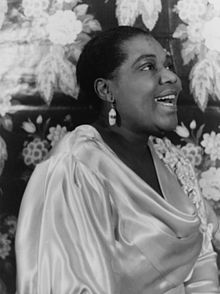
Portrait of Bessie Smith by Carl Van Vechten
All contemporary accounts indicate that while Rainey did not teach Smith to sing, she probably helped her develop a stage presence.
[6] Smith began forming her own act around 1913, at Atlanta's "81" Theater. By 1920, Smith had established a reputation in the
South and along the
Eastern Seaboard.
In 1920, sales figures of over 100,000 copies for "Crazy Blues," an
Okeh Records recording by singer
Mamie Smith (no relation) pointed to a new market. The recording industry had not directed its product to blacks, but the success of the record led to a search for female blues singers. Bessie Smith was signed to
Columbia Records in 1923 by
Frank Walker, a talent agent who had seen her perform years earlier. Her first session for Columbia was February 15, 1923. For most of 1923, her records were issued on Columbia's regular A- series; when the label decided to establish a "
race records" series, Smith's "Cemetery Blues" (September 26, 1923) was the first issued.
She scored a big hit with her first release, a coupling of "Gulf Coast Blues" and "
Downhearted Blues", which its composer
Alberta Hunter had already turned into a hit on the
Paramount label. Smith became a headliner on the black T.O.B.A. circuit and rose to become its top attraction in the 1920s.
[7] Working a heavy theater schedule during the winter months and doing tent tours the rest of the year (eventually traveling in her own railroad car), Smith became the highest-paid black entertainer of her day.
[8] Columbia nicknamed her "Queen of the Blues," but a PR-minded press soon upgraded her title to "Empress".
Smith had a powerfully strong voice that recorded very well from her first record, made during the time when recordings were made acoustically. With the coming of electrical recording (her first electrical recording was "Cake Walking Babies (From Home)" recorded Tuesday, May 5, 1925),
[9] the sheer power of her voice was even more evident. She was also able to benefit from the new technology of radio broadcasting, even on stations that were in the segregated south. For example, after giving a concert for a white-only audience at a local theater in Memphis, Tennessee, in October 1923, she then performed a late night concert on station WMC, where her songs were very well received by the radio audience.
[10]
Broadway[edit]
Smith's career was cut short by a combination of the Great Depression, which nearly put the recording industry out of business, and the advent of "talkies", which spelled the end for vaudeville. She never stopped performing, however. While the days of elaborate vaudeville shows were over, Smith continued touring and occasionally singing in clubs. In 1929, she appeared in a
Broadway flop called
Pansy, a musical in which top critics said she was the only asset.
In 1929, Smith made her only film appearance, starring in a two-reeler titled
St. Louis Blues, based on
W. C. Handy's
song of the same name. In the film, directed by
Dudley Murphy and shot in
Astoria, she sings the title song accompanied by members of
Fletcher Henderson's orchestra, the Hall Johnson Choir, pianist
James P. Johnson and a string section—a musical environment radically different from any found on her recordings.
Swing era[edit]
In 1933,
John Hammond, who also mentored
Billie Holiday, asked Smith to record four sides for Okeh (which had been acquired by Columbia Records in 1925). He claimed to have found her in semi-obscurity, working as a hostess in a speakeasy on Philadelphia's Ridge Avenue.
[11] Bessie Smith worked at Art's Cafe on Ridge Avenue, but not as a hostess and not until the summer of 1936. In 1933, when she made the Okeh sides, Bessie was still touring. Hammond was known for his selective memory and gratuitous embellishments.
[12]
Bessie Smith was paid a non-royalty fee of $37.50 for each selection and these Okeh sides, which were her last recordings. Made on November 24, 1933, they serve as a hint of the transformation she made in her performances as she shifted her blues artistry into something that fit the "
swing era". The relatively modern accompaniment is notable. The band included such
swing era musicians as
trombonist Jack Teagarden,
trumpeter Frankie Newton,
tenor saxophonist Chu Berry,
pianist Buck Washington, guitarist Bobby Johnson, and
bassist Billy Taylor.
Benny Goodman, who happened to be recording with
Ethel Waters in the adjoining studio, dropped by and is barely audible on one selection. Hammond was not entirely pleased with the results, preferring to have Smith revisit her old blues groove. "Take Me for a Buggy Ride" and "Gimme a Pigfoot (And a Bottle of Beer)", both written by
Wesley Wilson, continue to be ranked among her most popular recordings.
[3] Billie Holiday, who credited Smith as her major influence along with
Louis Armstrong, would go on to record her first record for Columbia three days later with the same band personnel.
On September 26, 1937, Smith was critically injured in a car accident while traveling along
U.S. Route 61 between
Memphis, Tennessee, and
Clarksdale, Mississippi. Her lover, Richard Morgan, was driving and misjudged the speed of a slow-moving truck ahead of him. Tire marks at the scene suggested that Morgan tried to avoid the truck by driving around its left side, but he hit the rear of the truck side-on at high speed. The tailgate of the truck sheared off the wooden roof of Smith's old Packard. Smith, who was in the passenger seat, probably with her right arm or elbow out the window, took the full brunt of the impact. Morgan escaped without injuries.
The first people on the scene were a Memphis surgeon, Dr. Hugh Smith (no relation), and his fishing partner Henry Broughton. In the early 1970s, Dr. Smith gave a detailed account of his experience to Bessie's biographer Chris Albertson. This is the most reliable eyewitness testimony about the events surrounding Bessie Smith's death.
After stopping at the accident scene, Dr. Smith examined Bessie Smith, who was lying in the middle of the road with obviously severe injuries. He estimated she had lost about a half-pint of blood, and immediately noted a major traumatic injury to her right arm; it had been almost completely severed at the elbow.
[13] But Dr. Smith was emphatic that this arm injury alone did not cause her death. Although the light was poor, he observed only minor head injuries. He attributed her death to extensive and severe crush injuries to the entire right side of her body, consistent with a "sideswipe" collision.
[14]
Broughton and Dr. Smith moved the singer to the shoulder of the road. Dr. Smith dressed her arm injury with a clean handkerchief and asked Broughton to go to a house about 500 feet off the road to call an ambulance.
By the time Broughton returned approximately 25 minutes later, Bessie Smith was in shock. Time passed with no sign of the ambulance, so Dr. Smith suggested that they take her into Clarksdale in his car. He and Broughton had almost finished clearing the back seat when they heard the sound of a car approaching at high speed. Dr. Smith flashed his lights in warning, but the oncoming car failed to stop and plowed into the doctor's car at full speed. It sent his car careening into Bessie Smith's overturned Packard, completely wrecking it. The oncoming car ricocheted off Dr. Smith's car into the ditch on the right, barely missing Broughton and Bessie Smith.
[15]
The young couple in the new car did not have life-threatening injuries. Two ambulances arrived on the scene from Clarksdale; one from the black hospital, summoned by Mr. Broughton, the other from the white hospital, acting on a report from the truck driver, who had not seen the accident victims.
Bessie Smith was taken to Clarksdale's
G. T. Thomas Afro-American Hospital, where her right arm was
amputated. She died that morning without regaining consciousness. After Smith's death, an often repeated but now discredited story emerged about the circumstances; namely, that she had died as a result of having been refused admission to a "
whites only" hospital in Clarksdale. Jazz writer/producer
John Hammond gave this account in an article in the November 1937 issue of
Down Beat magazine. The circumstances of Smith's death and the rumor promoted by Hammond formed the basis for
Edward Albee's 1959 one-act play
The Death of Bessie Smith.
[16]
"The Bessie Smith ambulance would
not have gone to a white hospital, you can forget that." Dr. Smith told Albertson. "Down in the
Deep South cotton country, no ambulance driver, or white driver, would even have thought of putting a colored person off in a hospital for white folks."
[17]

Smith's death certificate
Smith's funeral was held in
Philadelphia a little over a week later on October 4, 1937. Her body was originally laid out at Upshur's funeral home. As word of her death spread through Philadelphia's black community, the body had to be moved to the O.V. Catto Elks Lodge to accommodate the estimated 10,000 mourners who filed past her coffin on Sunday, October 3.
[18]Contemporary newspapers reported that her funeral was attended by about seven thousand people. Far fewer mourners attended the burial at Mount Lawn Cemetery, in nearby
Sharon Hill. Gee thwarted all efforts to purchase a stone for his estranged wife, once or twice pocketing money raised for that purpose.
[19]
Unmarked grave[edit]
The grave remained unmarked until August 7, 1970, when a tombstone—paid for by singer
Janis Joplin and Juanita Green, who as a child had done housework for Smith—was erected.
[20]
Hit records[edit]
Selective awards and recognition[edit]
Grammy Hall of Fame[edit]
Recordings of Bessie Smith were inducted into the
Grammy Hall of Fame. This special Grammy Award was established in 1973 to honor recordings that are at least 25 years old and that have "qualitative or historical significance".
National Recording Registry[edit]
Inductions[edit]
U.S. Postage Stamp
Digital remastering[edit]
Technical faults in the majority of her original
gramophone recordings—especially variations in recording speed, which raised or lowered the apparent
pitch of her voice, misrepresented the "light and shade" of her phrasing, interpretation and delivery. They altered the apparent
key of her performances (sometimes raised or lowered by as much as a
semitone). The fact that the "centre hole" in some of the master recordings had not been in the true middle of the master disc meant that there were wide variations in tone, pitch, key and phrasing, as commercially released records revolved around the spindle.
Given those historic limitations, the current
digitally remastered versions of her work deliver significant, very positive differences in the sound quality of Smith's performances. Some critics believe that the American
Columbia Records compact disc releases are somewhat inferior to subsequent transfers made by the late
John R. T. Davies for
Frog Records.
[28]
In popular culture[edit]
- The 1948 short story "Blue Melody" by J. D. Salinger and the 1959 play The Death of Bessie Smith by Edward Albee are both based on Smith's life and death, but poetic license is taken by both authors; for instance, Albee's play distorts the circumstances of her medical treatment, or lack thereof, prior to her demise, attributing it to racist medical practitioners.
- Bessie's Back In Town, a new musical in production by Barry Edelson, avoids the poetic-license issue, as it accurately as possible presents true and major aspects of her life, as well as her death, while remaining true to her music.[29]
- Playwright Angelo Parra wrote the 2001 musical play The Devil's Music: The Life and Blues of Bessie Smith, with Miche Braden in the title role
- The video game series BioShock (1 and 2) Bessie Smith is portrayed as a cameo of a character by the name of Grace Holloway. Bessie Smith's music can be heard during the loading screen and in the level Paupers Drop, and in the various hallways and rooms of the sunken city. Her 1929 song "I'm Wild About That Thing" additionally makes an anachronistic appearance in its sequel BioShock: Infinite, set in 1912.
- HBO released a movie about Smith, called Bessie, starring Queen Latifah on May 16, 2015.[30]
___________________________________________________________________________________
Bessie Smith, in full
Elizabeth Smith (born April 15, 1898?,
Chattanooga, Tenn., U.S.—died Sept. 26, 1937,
Clarksdale, Miss.), American singer, one of the greatest of
blues vocalists.
Smith grew up in poverty and obscurity. She may have made a first public appearance at the age of eight or nine at the Ivory Theatre in her hometown. About 1919 she was discovered by
Gertrude "Ma" Rainey, one of the first of the great blues singers, from whom she received some training. For several years Smith traveled through the South
singing in tent shows and bars and theatres in small towns and in such cities as Birmingham, Alabama;
Memphis, Tennessee; and Atlanta and Savannah, Georgia. After 1920 she made her home in
Philadelphia, and it was there that she was first heard by Clarence Williams, a representative of Columbia Records. In February 1923 she made her first recordings, including the classic “
Down Hearted Blues,” which became an enormous success, selling more than two million copies. She made 160 recordings in all, in many of which she was accompanied by some of the great
jazz musicians of the time, including
Fletcher Henderson,
Benny Goodman, and
Louis Armstrong.
Bessie Smith’s subject matter was the classic material of the blues: poverty and oppression, love—betrayed or unrequited—and stoic acceptance of defeat at the hands of a cruel and indifferent world. The great tragedy of her career was that she outlived the topicality of her idiom. In the late 1920s her record sales and her fame diminished as social forces changed the face of popular
music and bowdlerized the earthy realism of the sentiments she expressed in her music. Her gradually increasing alcoholism caused managements to become wary of engaging her, but there is no evidence that her actual singing ability ever declined.
Known in her lifetime as the “Empress of the Blues,” Smith was a bold, supremely confident artist who often disdained the use of a microphone and whose art expressed the frustrations and hopes of a whole generation of black Americans. Her tall figure and upright stance, and above all her handsome features, are preserved in a short motion picture,
St. Louis Blues (1929), banned for its realism and now preserved in the Museum of Modern Art, New York City. She died from injuries sustained in a road accident. It was said that, had she been white, she would have received earlier medical treatment, thus saving her life, and
Edward Albee made this the subject of his play
The Death of Bessie Smith (1960).
_________________________________________________________________________________
Bessie Smith, in full Elizabeth Smith (b. April 15, 1894 (1898?), Chattanooga, Tennessee —d. September 26, 1937, Clarksdale, Mississippi) was an American singer and one of the greatest of blues vocalists.
Smith grew up in poverty and obscurity. She may have made a first public appearance at the age of eight or nine at the Ivory Theatre in her hometown. About 1919 she was discovered by Gertrude "Ma" Rainey, one of the first of the great blues singers, from whom she received some training. For several years Smith traveled through the South singing in tent shows and bars and theaters in small towns and in such cities as Birmingham, Alabama; Memphis, Tennessee; and Atlanta and Savannah, Georgia. After 1920 she made her home in Philadelphia, and it was there that she was first heard by Clarence Williams, a representative of Columbia Records. In February 1923 she made her first recordings, including the classic “Down Hearted Blues,” which became an enormous success, selling more than two million copies. She made 160 recordings in all, in many of which she was accompanied by some of the great jazz musicians of the time, including Fletcher Henderson, Benny Goodman, and Louis Armstrong.
Bessie Smith’s subject matter was the classic material of the blues: poverty and oppression, love—betrayed or unrequited—and stoic acceptance of defeat at the hands of a cruel and indifferent world. The great tragedy of her career was that she outlived the topicality of her idiom. In the late 1920s her record sales and her fame diminished as social forces changed the face of popular music and passed over the earthy realism of the sentiments she expressed in her music. Her gradually increasing alcoholism caused managements to become wary of engaging her, but there is no evidence that her actual singing ability ever declined.
Known in her lifetime as the “Empress of the Blues,” Smith was a bold, supremely confident artist who often disdained the use of a microphone and whose art expressed the frustrations and hopes of a whole generation of African Americans. Her tall figure and upright stance, and above all her handsome features, are preserved in a short motion picture, St. Louis Blues (1929), banned for its realism and now preserved in the Museum of Modern Art, New York City. She died from injuries sustained in a road accident. It was said that, had she been white, she would have received earlier medical treatment, thus saving her life, and Edward Albee made this the subject of his play The Death of Bessie Smith (1960).


.jpg)